
Microgreen Greenhouse Monitoring: Detecting Microclimate Failures Before They Destroy Crops
1. Introduction
Microgreen crop failures begin quietly. In the spaces of a commercial or experimental multi-tier greenhouse, a small area of poor air movement develops without anyone noticing. This tiny zone traps moisture from the plants' own transpiration between the tightly packed seedling trays. Still air allows fungal spores to grow unnoticed. At the same time, constant dampness slowly wears down the connections of conventional sensors used to monitor greenhouse air. In every case, conditions deteriorate quietly. Where high relative humidity meets stagnant air, damping-off mold and rot rapidly spread.
That environmental shift is the crucial early warning sign. If ignored, it damages stems, destroys entire seedling trays within 24 hours, halts production plans unexpectedly, and spoils commercial market yields. The primary challenge is that a developing failure appears completely normal to the naked eye until the crop collapses.
Using automated sensors, robotic gantry machines, and computer vision enables growers to spot these subtle, localized environmental shifts in real time—intervening while there is still time to act and safeguard the harvest.
2. How Automated Sensing Works
Environmental conditions change constantly across micro-zones, much like air currents shifting beneath a dense tree canopy. Fixed wall-mounted sensors and intermittent human visual inspections cannot detect localized moisture pockets or early signs of harmful pathogens deep inside tall, tiered shelving racks.
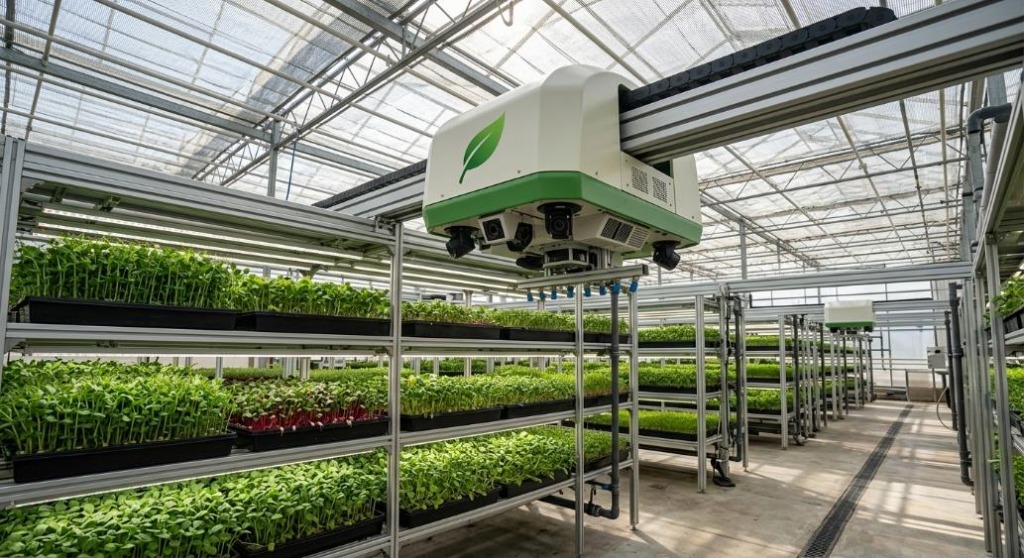
An automated Eco-Bot Gantry System bridges this operational gap. Suspended from precision overhead rails, the robot travels continuously along the greenhouse aisles, positioning multi-sensor payload heads millimeters above the plant canopy on each shelf tier.
Its cameras and environmental sensors collect up-to-the-minute data across every tray layer:
- Localized Spatial Mapping: Rather than calculating a deceptive room-wide average, the mobile robotic platform maps temperature, humidity, and micro-airflow variations directly at the leaf surface.
- Spatial Stress Distribution: The system tracks multi-dimensional spatial variance, identifying high-risk humidity pockets before spores can colonize adjacent crops.
3. Engineering Architecture & Component Breakdown
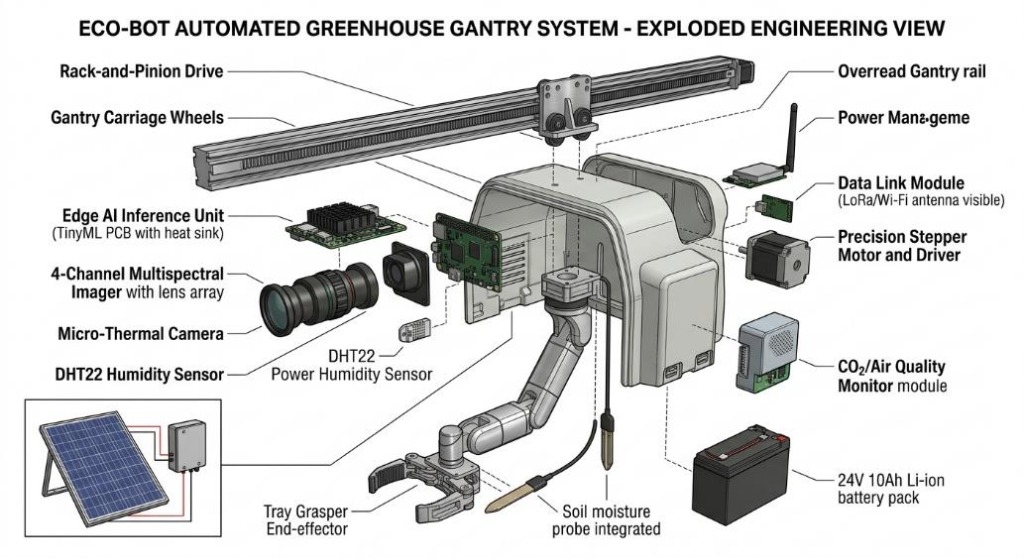
The Eco-Bot automated greenhouse gantry integrates mechanical, electronic, and sensory modules into an IP67-rated enclosure engineered specifically for humid commercial greenhouse environments:
Key Hardware Subsystems:
- Rack-and-Pinion Overhead Drive: Ensures smooth, vibration-free traverse along the structural gantry rails.
- Precision Stepper Motors & Drivers: Delivers millimeter-accurate positioning across horizontal and vertical axes.
- 4-Channel Multispectral Imager & Lens Array: Captures key reflectance bands to compute localized vegetative stress indices.
- Micro-Thermal Radiometric Camera: Pinpoints micro-temperature anomalies and evaporative cooling variations across seedling canopies.
- Integrated DHT22 Humidity & Temperature Probes: Continuously logs ambient air conditions adjacent to the leaves.
- CO₂ & Air Quality Monitoring Module: Tracks photosynthetic activity and ventilation exchange rates.
- Substrate Soil Moisture Needle Probe: Verifies root-zone moisture saturation levels.
- End-Effector Tray Grasper: Enables automated physical sampling and tray repositioning.
- Edge AI Inference Board: Onboard TinyML processor with custom passive heat dissipation.
- Wireless Data Link & Power: Dual LoRa / Wi-Fi telemetry module backed by an onboard 24V 10Ah Li-ion battery and supplementary solar docking recharge.
4. Onboard TinyML & Edge Processing
To guarantee rapid operational response times and eliminate dependence on continuous internet or cloud connectivity, the gantry utilizes an onboard Edge AI Inference Unit.
This unit executes quantized Convolutional Neural Network (CNN) models locally on the edge microcontroller. Data from the 4-channel multispectral camera and thermal imaging array is preprocessed directly on the moving bot. The system detects visual signatures of early-stage fungal infection—such as damping-off spores and leaf translucency—in less than 800 milliseconds per tray.
5. Key Operational Benefits
- Predictive Crop Protection: Automated interventions occur the exact moment sensor thresholds detect anomaly patterns, preventing crop collapse before physical damage manifests.
- Substantial Reduction in Crop Loss: Resolves hyper-localized microclimate failures before aggressive pathogens spread across adjacent trays.
- Enhanced Operational Efficiency: Continuous autonomous inspections relieve farm staff from repetitive, error-prone manual spot checks.
- Significant Cost Savings: Early micro-ventilation or lighting adjustments are vastly more economical than wholesale crop write-offs, wasted seed stock, and missed distribution contracts.
- Non-Contact Inspection: High-speed contactless optical scans protect delicate young seedlings from physical bruising or mechanical disturbance.
- Comprehensive Historical Documentation: Automatically archived thermal heatmaps and environmental time-series records provide complete traceability across every cultivation cycle.
6. Limitations and Safety Precautions
While automated sensing and robotic visual monitoring provide immense operational advantages, effective implementation requires strict adherence to engineering safety protocols:
- Sensor Calibration & Emissivity: Plant leaves, damp organic substrates, and aluminum structural frames exhibit distinct emissivity profiles. Probes must be calibrated to avoid erroneous radiometric readings.
- Transient External Conditions: Solar flashes through greenhouse glazing and sudden cross-ventilation drafts can induce momentary sensor noise, necessitating temporal filtering algorithms.
- Surface-Level vs. Subterranean Limits: Optical and thermal computer vision inspect the upper canopy surface; subterranean root diseases require supplementary electrical conductivity (EC) or physical root-zone probe verification.
- Operational System Health: Automated alerts rely on robust software health, routine probe cleaning, and reliable local communication networks.
- Qualified Agronomic Oversight: Machine alerts must inform trained agronomic personnel who follow established greenhouse response standard operating procedures (SOPs).
- Electrical & Moisture Isolation (IP67): Given extreme humidity levels (often >85% RH), all motor drivers, battery packs, and PCB enclosures must adhere to watertight IP67 standards.
- Mechanical Clearance & Limit Switches: Overhead tracks require physical end-stops and optical obstacle collision avoidance to prevent rail binding and protect structural framework.
7. Real-World Case Example
During an automated sweep of an industrial multi-tier vertical microgreen facility cultivating thousands of trays of arugula and radish, the system detected a localized anomaly:
- The Hidden Micro-Zone Failure: While centralized environmental sensors indicated nominal room conditions (65% RH), transpiration from dense middle-shelf trays created a stagnant micro-pocket where humidity surged past 85% RH.
- Autonomous Edge AI Detection: As the gantry bot scanned the rack, its thermal and multispectral cameras identified elevated leaf temperature and subtle spectral shifts on a single tray corner—indicators imperceptible to manual visual inspections.
- Autonomous Corrective Action: The system logged rack coordinates, immediately triggered an auxiliary micro-ventilation duct directly over the affected tier, and adjusted localized LED PAR lighting to accelerate canopy drying. A priority notification was simultaneously dispatched to the facility dashboard.
- Outcome & Economic Impact: The intervention arrested the outbreak of Pythium (damping-off) mold within minutes. In conventional setups, such a pocket would have gone unnoticed for 24 to 48 hours, destroying the entire batch. The facility averted crop write-offs, avoided chemical fungicide use, and fulfilled commercial supermarket delivery deadlines on schedule.
8. The Future of Microgreen Greenhouse Monitoring
Controlled-environment agriculture (CEA) is rapidly evolving from manual oversight to fully autonomous, data-driven ecosystems:
- Decentralized TinyML Intelligence: Next-generation gantry robots will execute increasingly sophisticated multi-task neural networks on low-power microcontrollers, identifying nutrient deficiencies and pathogen vectors in real time without cloud latency.
- Autonomous Multimodal Robotics: Future gantry systems will integrate micro-actuators capable of localized micro-dosing, targeted ultraviolet sanitization, and automated robotic harvesting.
- Unified Agricultural IoT Platforms: Sensor telemetry, battery management metrics, and irrigation logs will merge into predictive centralized dashboards, allowing farm managers to forecast harvest schedules and optimize energy efficiency across regional farming networks.
9. Conclusion
Greenhouse crop failures rarely occur without warning. By converting imperceptible microclimate shifts into actionable automated alerts, computer vision and robotic gantry systems transform microgreen cultivation from a high-risk gamble into a predictable, high-yield engineering process.
10. References & Standards
- ISO 18434-1:2008: Condition monitoring and diagnostics of machines — Thermography — Part 1: General procedures.
- Fluke Corporation: What is Thermal Imaging? How Infrared Cameras Work and Hot Spot Detection.
- FLIR Systems: Thermal imaging for electrical and environmental inspections in industrial applications.
- Controlled-Environment Agriculture (CEA) Research: Academic studies on automated gantry sensor networks, IoT-driven microclimate control, and Edge AI (TinyML) implementations in vertical farming architectures.